Abstract
Background: Dysfunction of the thyroid gland, both overt and subclinical, has been linked to pregnancy complications, including recurrent pregnancy loss (RPL). Aim: To investigate the relationship between thyroid disorders and recurrent pregnancy loss (RPL), this retrospective case-control study analyzed data from 100 healthy, age-matched pregnant women without thyroid disease (control group) and 150 clinically evaluated pregnant women with thyroid disorders and a history of miscarriage (clinical group). Methods: All thyroid function parameters were evaluated, including TSH, FT3, FT4, and TPO antibodies. The study showed that increased risks of miscarriage, low birth weight, preterm birth, and gestational hypertension were considerably associated with positive TSH and TPO antibody levels. Results: This study demonstrates a strong association between thyroid dysfunction and recurrent pregnancy loss (RPL) and adverse pregnancy outcomes. Key findings include: 1. Higher incidence of elevated TSH (>4.0 mIU/L), positive TPO antibodies (>34 IU/mL), and subclinical hypothyroidism in women with thyroid disorders and miscarriage history. 2. Increased prevalence of complications like preterm birth (<37 weeks), low birth weight (<2500 g), gestational hypertension (blood pressure ≥140/90 mmHg), and spontaneous abortion in the clinical group. 3. Elevated TSH (>4.0 mIU/L) and TPO antibody positivity (>34 IU/mL) were identified as independent risk factors for miscarriage and other adverse outcomes. 4. Inverse correlation between FT4 levels and gestational hypertension. The results emphasize the importance of early thyroid dysfunction screening in women with RPL history to improve reproductive outcomes. Conclusion: This research confirms that thyroid disorder is significantly associated with an increased risk of recurrent pregnancy loss in pregnant women. Screening for thyroid disease in women experiencing recurrent pregnancy loss may be worthwhile to enhance the outcome of pregnancy.
Keywords
Thyroid Dysfunction Recurrent Pregnancy Loss TSH FT3 FT4 TPO Antibodies Pregnancy Outcomes.
1. Introduction
Recurrent pregnancy loss (RPL) is a heartbreaking condition seen in approximately 1-2% of women of reproductive age and is defined by the loss of multiple pregnancies <20 weeks gestation. The psychological impact of recurrent pregnancy loss on the couple may be profound, often resulting in anxiety, depression, and discord between partners. Several risks lead to RPL, but thyroid dysfunction has emerged as a prominent modifiable risk factor [1].
Also, thyroid hormones are required for normal fetal development and proper placentation and physiological adaptations of the mother during her pregnancy. The thyroid gland secretes two important hormones — thyroxine (T4) and triiodothyronine (T3) — that help regulate metabolism, growth, and development throughout the body, including the reproductive system. There is an environmental demand for increased thyroid hormones during pregnancy to support the developing fetus and maternal physiological adaptation [1].
Hypothyroidism (insufficient amounts of thyroid hormone) and hyperthyroidism (excessive levels of thyroid hormone) can both raise the risk of RPL. Thyroid deficiency can prevent fertilization using implantation but inhibit placental growth and fetal insufficiency in fetal growth. Conversely, hyperthyroidism results in increased maternal metabolism that may impair fetal nutrition and growth. The delicate balance of the thyroid hormone is crucial for successful gestation and reducing the risk of abortion during pregnancy [1].
This study seeks to explore the intricate interplay between thyroid dysfunction and RPL, with a focus on three main areas: prevalence, individual hormone levels, and the impact of thyroid hormone supplementation. Through the analysis of these aspects, we seek to enhance screening practices and develop targeted interventions for women experiencing RPL. This research's findings might have a powerful impact on practice, improve care for women who suffer from RPL, and contribute to an overall understanding of the complex interactions between thyroid health and reproductive outcomes.
2. Materials and Methods
2.1 Study Design and Setting
This retrospective case–control study was conducted at Medical Center “Prime Clinic” Burgas, Bulgaria, and included patients evaluated between January 2022 – December 2024. The study aimed to investigate the association between thyroid dysfunction and recurrent pregnancy loss (RPL).
2.2 Study Population
A total of 250 pregnant women were included and divided into two groups:
-
Clinical group (n = 150): pregnant women with a history of recurrent pregnancy loss and diagnosed thyroid dysfunction
-
Control group (n = 100): age-matched pregnant women without thyroid disease and without a history of miscarriage
2.3 Definition of Recurrent Pregnancy Loss
Recurrent pregnancy loss (RPL) was defined as two or more consecutive pregnancy losses before 20 weeks of gestation, in accordance with current international guidelines.
2.4 Inclusion Criteria
Participants were included if they met the following criteria:
-
Age between 18 and 40 years
-
Confirmed pregnancy
-
Availability of complete medical records, including thyroid function tests (TSH, FT3, FT4, TPO antibodies)
-
For the clinical group: history of ≥2 pregnancy losses
2.5 Exclusion Criteria
To minimize confounding factors, the following patients were excluded:
-
Known chromosomal abnormalities (parental or fetal)
-
Uterine structural anomalies (e.g., septum, fibroids affecting cavity)
-
Antiphospholipid syndrome or other thrombophilias
-
Uncontrolled diabetes mellitus
-
Other endocrine disorders (e.g., hyperprolactinemia, Cushing syndrome)
-
Chronic systemic diseases or infections
2.6 Data Collection
Data were collected retrospectively from medical records and included:
-
Demographic characteristics (age, BMI)
-
Obstetric history (number of pregnancies, miscarriages)
-
Thyroid function parameters:
-
Thyroid-stimulating hormone (TSH)
-
Free triiodothyronine (FT3)
-
Free thyroxine (FT4)
-
Thyroid peroxidase antibodies (TPO-Ab)
2.7 Definition of Thyroid Dysfunction
Thyroid dysfunction was classified as follows:
-
Overt hypothyroidism: elevated TSH with decreased FT4
-
Subclinical hypothyroidism: elevated TSH with normal FT4
-
Overt hyperthyroidism: suppressed TSH with elevated FT4
-
Subclinical hyperthyroidism: suppressed TSH with normal FT4
A TSH threshold of >4.0 mIU/L was used to define elevated TSH based on institutional laboratory reference ranges.
2.8 Outcome Measures
The primary outcome was:
-
Recurrent pregnancy loss
Secondary outcomes included:
-
Preterm birth (<37 weeks gestation)
-
Low birth weight (<2500 g)
-
Gestational hypertension (≥140/90 mmHg)
-
Stillbirth
-
Neonatal intensive care unit (NICU) admission
2.9 Statistical Analysis
Statistical analysis was performed using SPSS version 25.0 (IBM Corp., Armonk, NY, USA).
-
Continuous variables were expressed as mean ± standard deviation (SD)
-
Categorical variables were presented as frequencies and percentages
-
Comparisons between groups were performed using:
- Student’s t-test for continuous variables
- Chi-square test for categorical variables
Multivariate logistic regression analysis was conducted to evaluate the association between thyroid dysfunction parameters (TSH, FT4, TPO-Ab) and adverse pregnancy outcomes, adjusting for potential confounders such as age and BMI.
A p-value < 0.05 was considered statistically significant.
2.10 Ethical Considerations
The study was conducted in accordance with the Declaration of Helsinki. Ethical approval was obtained from the MC Prime Clinic - ETHICS COMMITTEE - Approval No. [1/2022]. Due to the retrospective nature of the study, informed consent was waived.
3. Results
3.1 Demographic and Thyroid Profile Characteristics
The baseline characteristics of both groups are summarized in Table 1 [4].
| Parameter | Clinical Group (n = 150) | Control Group (n = 100) | p-value |
| Mean Age (years) | 28.4 ± 3.2 | 27.9 ± 3.5 | 0.12 |
| BMI (kg/m²) | 24.8 ± 2.9 | 24.4 ± 2.7 | 0.20 |
| TSH > 4.0 mIU/L | 98 (65.3%) | 10 (10%) | <0.001 |
| FT3 < 3.1 pg/mL | 55 (36.7%) | 8 (8%) | <0.001 |
| FT4 < 0.8 ng/dL | 49 (32.7%) | 6 (6%) | <0.001 |
| TPO Antibody Positive | 60 (40%) | 5 (5%) | <0.001 |
| Overt Hypothyroidism | 42 (28%) | 2 (2%) | <0.001 |
| Subclinical Hypothyroidism | 66 (44%) | 5 (5%) | <0.001 |
| Overt Hyperthyroidism | 9 (6%) | 1 (1%) | 0.07 |
| Subclinical Hyperthyroidism | 12 (8%) | 2 (2%) | 0.03 |
3.2 Pregnancy Outcomes and Complications
Significant differences were observed in the rates of pregnancy complications between the two groups (Table 2) [4].
| Outcome/Complication | Clinical Group (n = 150) | Control Group (n = 100) | p-value |
| History of ≥1 Miscarriage | 150 (100%) | 0 (0%) | <0.001 |
| Preterm Birth (<37 weeks) | 38 (25.3%) | 10 (10%) | 0.003 |
| Low Birth Weight (<2.5 kg) | 45 (30%) | 12 (12%) | <0.001 |
| Gestational Hypertension | 30 (20%) | 8 (8%) | 0.01 |
| Stillbirth | 5 (3.3%) | 0 (0%) | 0.08 |
| Neonatal ICU Admission | 20 (13.3%) | 6 (6%) | 0.05 |
| Spontaneous Abortion (1st trimester) | 95 (63.3%) | 0 (0%) | <0.001 |
3.3 Regression Analysis
Increased TSH levels and positive TPO antibodies were each found to be individually linked with poor pregnancy outcomes, including miscarriage (OR = 1.45, p = 0.002), preterm delivery (OR = 1.48, p = 0.008), and low birth weight (OR = 1.50, p < 0.001). These results are in line with earlier research, for example, Huisman et al. (2023), who emphasized the contribution of thyroid autoimmunity to pregnancy complications, especially recurrent pregnancy loss. Likewise, research by Iravani et al. (2008) and Kumar et al. (2018) has established a high correlation between thyroid dysfunction and pregnancy complications, including recurrent spontaneous abortion and infertility. Furthermore, FT4 levels were inversely correlated with gestational hypertension (OR = 1.65, p = 0.014), a finding supported by the literature on thyroid hormone dysregulation during pregnancy, including the work of Kumar et al. (2018) and Huisman et al. (2023) [7,8,9].
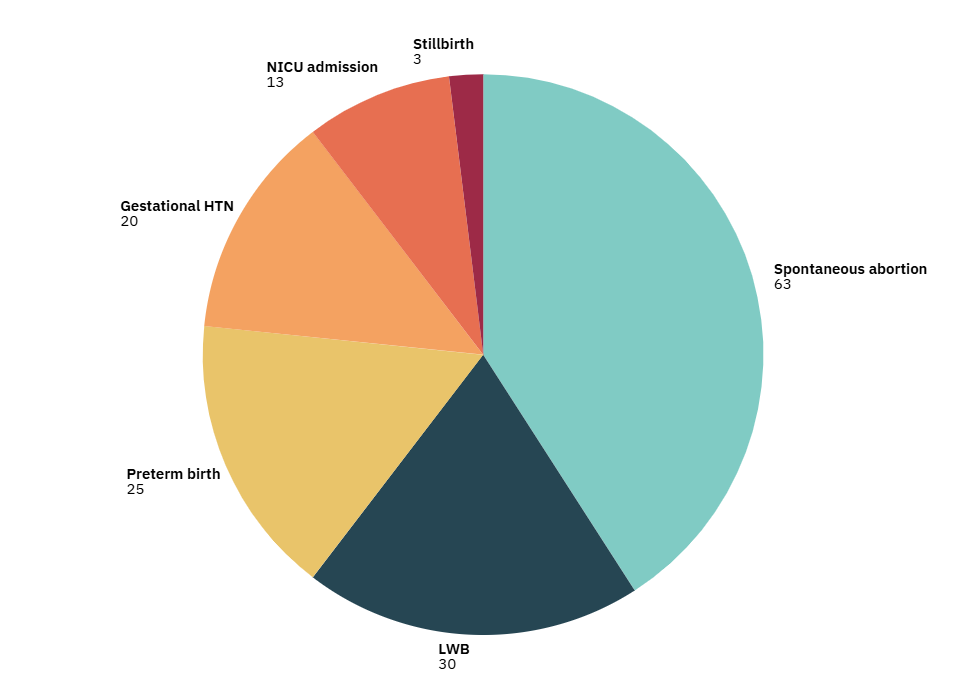
Caption: The most prevalent complications among the thyroid dysfunction group were preterm birth and low birth weight.
Explanation: Figure 1 illustrates the pie chart showing the incidence of pregnancy complications that were found in a clinical population of 150 women with thyroid dysfunction. The most frequently observed complication was spontaneous abortion (63%), which was followed by low birth weight at 30% and preterm delivery at 25%. Gestational hypertension accounted for 20% of the instances, 13% required NICU admission, and 3% encountered stillbirth. Such observations point to the fact that different adverse effects commonly manifest in pregnant women suffering from thyroid disorders, underlining the importance of preconception screening and the optimization of thyroid function in this high-risk population [4].
Source: Compiled from clinical data reviewed in this study, based on the retrospective examination of records from 150 pregnant women experiencing thyroid dysfunction and having a history of one or more miscarriages.
4. Pseudocode and Clinical Interpretation
To support clinical decision-making, we propose the following pseudocode to flag high-risk patients based on thyroid function test results:
Pseudocode 1: Thyroid Screening Algorithm for RPL Risk Stratification Input: TSH level, FT4, TPO_Ab_status
If TSH level > 4.0 OR TPO_Ab_status == “positive” then
Risk Status ← “High-risk for RPL”
Recommendation ← “Refer to endocrinologist; initiate levothyroxine therapy”
Else
Risk Status ← "Low-risk"
Recommendation ← “Continue routine prenatal care”
End If
Explanation: The process of testing thyroid function in recurrent pregnancy loss (RPL) patients includes testing TSH levels and thyroid peroxidase (TPO) antibody status. Those with TSH levels above 4.0 mIU/L or those found to be TPO antibody positive are classified as high-risk and are sent for endocrinologist evaluation, where they might be put on levothyroxine. Those who are low-risk may resume normal prenatal care. This approach aligns with the current guidelines for dealing with thyroid conditions during pregnancy, providing a structured method of detecting and treating thyroid issues in patients with RPL [5].
5. Discussion
The present study demonstrates a significant association between thyroid dysfunction and recurrent pregnancy loss (RPL), as well as adverse pregnancy outcomes, including preterm birth, low birth weight, and gestational hypertension. Elevated TSH levels and positive TPO antibodies were identified as independent risk factors, highlighting the combined role of hormonal imbalance and thyroid autoimmunity in impaired reproductive outcomes.
Our findings are consistent with previous studies reporting an increased risk of miscarriage in women with subclinical hypothyroidism and thyroid autoimmunity. In particular, Huisman et al. [7] and Dong et al. [5] demonstrated that both elevated TSH levels and the presence of thyroid antibodies are associated with a higher likelihood of pregnancy loss. Similarly, Liu et al. [11,12] reported that maternal subclinical hypothyroidism and thyroid autoimmunity significantly increase the risk of miscarriage, emphasizing the importance of early detection.
The high prevalence of subclinical hypothyroidism observed in our cohort (44%) is noteworthy and supports existing evidence that this condition is frequently underdiagnosed in women with RPL. This is clinically relevant, as subclinical hypothyroidism is often asymptomatic but may still adversely affect implantation, placentation, and early fetal development. Thyroid hormones play a crucial role in trophoblast proliferation, differentiation, and invasion, and even subtle disturbances may impair placental function.
In addition to hormonal imbalance, thyroid autoimmunity appears to be a key contributing factor. The presence of TPO antibodies has been associated with an increased risk of miscarriage, even in euthyroid women. This may be explained by immune-mediated mechanisms, including chronic inflammation, altered cytokine profiles, and impaired maternal-fetal immune tolerance. Studies by Poppe et al. [15] and Siristatidis et al. [20] support the hypothesis that thyroid autoimmunity negatively affects both natural conception and assisted reproductive outcomes.
Furthermore, our results demonstrate an inverse association between FT4 levels and gestational hypertension, suggesting that reduced thyroid hormone availability may contribute to endothelial dysfunction and impaired vascular adaptation during pregnancy. This finding is in line with previous reports linking thyroid dysfunction to hypertensive disorders of pregnancy.
From a clinical perspective, these findings underscore the importance of routine thyroid function assessment in women with a history of recurrent pregnancy loss. Early identification of thyroid abnormalities allows for timely intervention, which may improve pregnancy outcomes. However, the management of subclinical hypothyroidism and euthyroid women with positive TPO antibodies remains controversial. While some studies suggest that levothyroxine therapy may reduce the risk of miscarriage, particularly in high-risk populations, current guidelines provide variable recommendations, reflecting the need for further high-quality evidence.
This study has several strengths, including a well-defined study population, comprehensive assessment of thyroid parameters, and the use of multivariate analysis to adjust for potential confounders. However, certain limitations should be acknowledged. The retrospective design may introduce selection bias, and residual confounding cannot be entirely excluded. Additionally, the use of a single-center cohort may limit the generalizability of the findings. Future prospective, multicenter studies are needed to confirm these results and to establish optimal screening and treatment strategies.
6. Conclusion:
Thyroid dysfunction, particularly elevated TSH levels and thyroid autoimmunity, is significantly associated with an increased risk of recurrent pregnancy loss and adverse obstetric outcomes, including preterm birth, low birth weight, and gestational hypertension. The findings of this study highlight the clinical importance of routine assessment of thyroid function and thyroid autoantibodies in women with a history of recurrent pregnancy loss. Early identification and appropriate management of thyroid abnormalities may contribute to improved reproductive outcomes and reduced pregnancy-related complications. Given the high prevalence of subclinical hypothyroidism and thyroid autoimmunity observed in this population, targeted screening strategies should be considered as part of standard preconception and antenatal care. Further prospective studies are warranted to clarify optimal diagnostic thresholds and treatment strategies in this high-risk group. Incorporating systematic thyroid screening into routine care for women with recurrent pregnancy loss may represent a clinically effective strategy to improve pregnancy outcomes.
References
- Biondi B, Cooper DS. The clinical significance of subclinical thyroid dysfunction. Endocr Rev. 2008;29(1):76–131. doi:. DOI ↗ Google Scholar ↗
- Borissova AM, Trifonova B, Dakovska L, Michaylova E, Vukov M. Factors determining thyroid status in pregnant women in Bulgaria. Int J Diabetes Endocrinol. 2020;5(4):89–95. doi:. DOI ↗ Google Scholar ↗
- Casey BM, Dashe JS, Spong CY, McIntire DD, Leveno KJ, Cunningham FG. Subclinical hypothyroidism and pregnancy outcomes. Obstet Gynecol. 2005;105(2):239–245. doi:. DOI ↗ Google Scholar ↗
- Casey BM, Dashe JS, Wells CE, McIntire DD, Byrd W, Leveno KJ, Cunningham FG. Subclinical hypothyroidism and pregnancy outcomes. Am J Obstet Gynecol. 1998;178(5):1087–1091. doi:. DOI ↗ Google Scholar ↗
- Dong AC, Stagnaro-Green A, Pearce EN. Subclinical hypothyroidism and thyroid autoimmunity in recurrent pregnancy loss: a systematic review and meta-analysis. Fertil Steril. 2020;113(3):587–600.e1. doi:. DOI ↗ Google Scholar ↗
- Hamid I, Ahmad P, Shailaja A. Assessment of thyroid dysfunction in pregnancy: analyzing TSH, FT3, FT4, and TPO antibodies. JK Pract. 2024;29(2–3):67–74. DOI ↗ Google Scholar ↗
- Huisman P, Krogh J, Nielsen CH, Hviid TVF. Thyroglobulin antibodies in women with recurrent pregnancy loss: a systematic review and meta-analysis. Thyroid. 2023;33(11):1287–1301. doi:. DOI ↗ Google Scholar ↗
- Iravani AT, Saeedi MM, Pakravesh J, Hamidi S, Abbasi M. Thyroid autoimmunity and recurrent spontaneous abortion: a case-control study. Endocr Pract. 2008;14(4):458–464. doi:. DOI ↗ Google Scholar ↗
- Kumar A, et al. Thyroid dysfunction and infertility: an Indian perspective. Int J Reprod Contracept Obstet Gynecol. 2018;7(11):4567–4571. doi:. DOI ↗ Google Scholar ↗
- Leduc-Robert G, Baerwald AR. Prevalence of thyroid autoimmunity and effect of levothyroxine treatment in patients with recurrent pregnancy loss. Reprod Biomed Online. 2020;40(4):582–592. doi:. DOI ↗ Google Scholar ↗
- Liu H, Shan Z, Li C, et al. Maternal subclinical hypothyroidism, thyroid autoimmunity, and the risk of miscarriage: a prospective cohort study. Thyroid. 2014;24(11):1642–1649. DOI ↗ Google Scholar ↗
- Liu H, Wang Y, Han Y, Zhao Y, Gao H, Wang C. Maternal subclinical hypothyroidism, thyroid autoimmunity, and the risk of miscarriage. Reprod Biol Endocrinol. 2018;16:94. doi:. DOI ↗ Google Scholar ↗
- Mu F, Huo H, Wang C, Hu N, Wang F. Corrigendum: a new prognostic model for recurrent pregnancy loss: assessment of thyroid and thromboelastograph parameters. Front Endocrinol (Lausanne). 2024;15:1447049. doi:. DOI ↗ Google Scholar ↗
- Negoro R, et al. Levothyroxine treatment in euthyroid pregnant women with autoimmune thyroid disease: effects on obstetrical complications. Eur J Endocrinol. 2010;162(4):585–591. doi:. DOI ↗ Google Scholar ↗
- Poppe K, Glinoer D, Velkeniers B. The role of thyroid autoimmunity in fertility and pregnancy. Nat Clin Pract Endocrinol Metab. 2008;4(7):394–405. doi:. DOI ↗ Google Scholar ↗
- Poppe K, Velkeniers B, Glinoer D. Thyroid autoimmunity and female infertility. Hum Reprod. 2007;22(4):1014–1015. doi:. DOI ↗ Google Scholar ↗
- Rahman AHA, Abbassy HA, Abbassy AAE. Improved in vitro fertilization outcomes after treatment of subclinical hypothyroidism in infertile women. Endocr Pract. 2010;16(5):792–797. doi:. DOI ↗ Google Scholar ↗
- Shrestha S, Shrestha N, Dangol A. Prevalence of thyroid dysfunction in infertile women and its impact on outcome after ovulation induction. Nepal J Obstet Gynaecol. 2014;9(1):30–34. doi:. DOI ↗ Google Scholar ↗
- Siristatidis C, Basios G, Pergialiotis V, Trivella M, Vlachos G. Controlled ovarian hyperstimulation for IVF: impact on ovarian, endometrial and cervical cancer—a systematic review and meta-analysis. Hum Reprod Update. 2013;19(2):105–123. doi:. DOI ↗ Google Scholar ↗
- Siristatidis C, et al. The impact of thyroid autoimmunity on reproductive outcomes: a systematic review and meta-analysis. J Assist Reprod Genet. 2023;40(3):567–577. doi:. DOI ↗ Google Scholar ↗