Abstract
The COVID-19 pandemic forced Algerian universities to rapidly scale up distance education (DE), durably transforming higher-education pedagogical practices. This article examines Algerian students' perceptions of distance-learning platforms (Moodle, Google Classroom, Zoom, Google Meet) through a questionnaire survey of 98 students from different levels and institutions. Results show a marked preference for videoconferencing platforms, perceived as more interactive, together with an overall positive reception of DE during the health crisis, but persistent dissatisfaction with online assessment methods, seen as poorly representative of students' actual learning. Chi-square goodness-of-fit tests confirm that response distributions differ significantly from a uniform or 50/50 split for every item examined (p < .001), and 95% Wilson confidence intervals are reported for all key proportions. These findings confirm and extend prior research on DE in Algeria and point to concrete avenues, diversifying assessment methods, training instructors, and strengthening Internet access for consolidating a sustainable hybrid teaching offer in the post-pandemic context.
Keywords
Distance Education Algerian higher Education Digital learning platforms E-learning
1. Introduction
Distance teaching/learning (DTL) is a global phenomenon that has gained considerable momentum in education, particularly in universities, in response to the challenges posed by the COVID-19 pandemic (Sun et al., 2020; Vidal, 2020). In Algeria, university institutions also had to adapt quickly to this new pedagogical modality, which presents both specific opportunities and constraints. This article sets out to analyze the challenges and prospects of DTL in the Algerian university system, drawing on a literature review and a survey of students.
DTL is defined as a mode of teaching and learning based on the use of information and communication technologies (ICT) to ensure communication between teachers and learners, as well as access to educational resources, independent of time and place constraints. DTL offers advantages such as improved access to higher education, strengthened digital skills among students, the promotion of pedagogical innovation, and flexibility in learning pathways (Bonfils, 2020; Lollia & Issaieva, 2020). However, it also raises challenges related to limited Internet access, socio-economic disparities among students, teacher training in ICT, the adaptation of curricula to online formats, and the assessment of learning (Arrar, 2021).
Traditionally, higher education in Algeria has been delivered face-to-face, with lectures, tutorials and practical work organized on university campuses. However, the evolution of ICT has opened up new possibilities for rethinking how teaching and learning are delivered (Bertrand, 2010; Vidal, 2020). The COVID-19 pandemic accelerated the shift towards DTL at Algerian universities, owing to social-distancing measures and travel restrictions that made face-to-face classes impossible. Algerian universities had to adopt alternative approaches to ensure pedagogical continuity, using online learning platforms, virtual classrooms and digital resources (Slimani & Bentahar, 2019; Lassassi et al., 2020).
This shift towards DTL at Algerian universities also raises questions about the future of higher education. What are students' preferences regarding online teaching platforms? Which forms of assessment are best suited to this mode of learning? What requirements are needed to better support this mode of assessment? In this article we explore these questions and examine students' opinions on online and distance teaching at the Algerian university, drawing on a survey conducted among a representative sample. We seek to identify which platforms are most accessible and best meet students' expectations and needs regarding online learning. We note that this survey complements other studies that have examined various aspects of DTL at the Algerian university (Slimani & Bentahar, 2019; Lassassi et al., 2020).
Building on this literature review, our study pursues three specific objectives: (1) to identify the distance-learning platforms most used and most appreciated by Algerian students; (2) to analyze the factors underlying their preferences; and (3) to assess their perception of the relevance of online assessment methods. We hypothesize that students favor platforms offering synchronous interaction (videoconferencing) over asynchronous content-management platforms, and that their satisfaction with DTL contrasts with a more pronounced dissatisfaction with its assessment methods. This work builds on recent research into the adoption of educational technology in Algerian universities, notably studies on hybrid learning (Laifa et al., 2023) and on institutional digital readiness (Zine et al., 2023, 2025).
2. Literature Review
2.1. Evolution of distance teaching/learning at the Algerian university
Distance teaching/learning (DTL) is a mode of teaching and learning based on the use of information and communication technologies (ICT) to ensure communication between teachers and learners, as well as access to educational resources, independent of time and place constraints. DTL has accelerated significantly in recent years, mainly in response to technological advances and the COVID-19 pandemic, which forced universities to adopt distance-teaching approaches to ensure pedagogical continuity during the health crisis (Darby, 2021).
This transition brought about profound changes in teaching methods and opened up new prospects for higher education (Bertrand, 2010).
Algerian universities began adopting various online learning platforms, such as Moodle, Google Classroom and other learning-management systems, to provide students and teachers with tools to share resources, take part in discussions, submit assignments and access educational content remotely (Slimani & Bentahar, 2019). These platforms enabled Algerian universities to reach a larger number of students and make higher education more accessible, particularly for those living in remote areas or facing mobility difficulties. Students also benefited from the flexibility offered by online learning, allowing them to organize their schedules around personal constraints.
However, implementing DTL at Algerian universities is not without challenges. Limited Internet access in certain regions, socio-economic disparities among students, the need to train teachers in the use of ICT, adapting curricula to online formats, and assessing learning are all factors that can hinder effective deployment (Arrar, 2021; Boufalta & Bessette, 2021). In addition, the COVID-19 pandemic posed a major challenge for university institutions, which had to adapt quickly by training teachers and setting up adequate technical infrastructure (Darby, 2021).
Despite these challenges, the evolution of DTL at the Algerian university opens up new prospects for higher education. This evolution is likely to persist beyond the pandemic and contribute to a lasting transformation of higher education in Algeria, offering more flexible learning opportunities and responding to the needs of an increasingly digital society. Since January 2023, cross-curricular and discovery subjects (foreign languages, methodology, ICT, etc.) have been taught exclusively at a distance (MESRS: Ministry of Higher Education & Scientific Research of Algeria).
Recent research confirms the trajectory described above. A large-scale study of 782 students across several Algerian universities shows that perceived ease of use and perceived usefulness of hybrid learning tools significantly determine students' satisfaction and future usage intentions (Laifa, Imani Giglou & Akhrouf, 2023). Similarly, an interpretive analysis of online teaching labs built on Moodle during the pandemic finds that pedagogical continuity largely met its learning objectives despite campus closures (Bengueddach, Boudia & Bouamrane, 2023). Finally, research using machine learning to assess the “e-learning readiness” of Algerian universities, based on the ADKAR model, shows that stakeholder awareness and motivation remain decisive levers for the sustainable adoption of DTL (Zine, Harrou, Terbeche & Bellahcene, 2023; Zine, Harrou, Terbeche & Sun, 2025).
2.2. Distance teaching/learning platforms used in Algeria
In Algeria, several distance teaching/learning technologies and platforms are used in universities to facilitate the transition to online teaching. Below is an overview of the main technologies and platforms used:
Moodle: Moodle is an open-source online learning platform widely used in Algerian universities (Boufalta & Bessette, 2021). It offers a wide range of features, such as resource sharing, discussion forums, online assignments and automated assessments. Moodle allows teachers to create interactive courses and provide educational material to students.
Google Classroom: Google Classroom is an intuitive, user-friendly online learning platform integrated into the Google Workspace suite. It allows teachers to create virtual classes, assign homework, communicate with students and share resources. Google Classroom also facilitates collaboration between students and offers seamless integration with other Google tools such as Google Docs and Google Drive (Okmawati, 2020).
Institutional platforms: Some Algerian universities have developed their own distance teaching/learning platforms to meet the specific needs of their program (CERIST: Research Centre For Scientific And Technical Information of Algeria/MESRS, 2020). These platforms are generally designed to host educational resources, facilitate interaction between students and teachers, and enable course and assessment management. It should be noted that these platforms can be used in a complementary manner, depending on teachers' preferences and the specific needs of each course.
Algerian universities have also set up technical infrastructure, such as videoconferencing rooms, to facilitate the live broadcast of classes and encourage real-time interaction between students and teachers. In addition to the distance teaching/learning platforms mentioned above, two other popular videoconferencing platforms are widely used by Algerian academics:
Zoom: Zoom is a videoconferencing platform that allows teachers and students to connect in real time, take part in online classes and collaborate remotely. Zoom offers features such as screen sharing, live chat, virtual meeting rooms and the ability to record sessions. Algerian universities frequently use Zoom for synchronous classes, team meetings and interactive discussions.
Google Meet: Google Meet is another videoconferencing platform widely used in Algerian universities. It allows teachers and students to meet online, take part in virtual classes and share resources in real time. Google Meet offers features such as group video calls, screen sharing, chat and session recordings. Zoom and Google Meet are appreciated for their ease of use, connection stability and user-friendliness.
These videoconferencing platforms allow teachers to maintain direct contact with students, deliver live classes, hold tutoring sessions and facilitate interactive discussions. They are also used for administrative meetings, academic committees and online conferences.
3. Material and methods
For this research we conducted a survey to gather Algerian university students' opinions on online and distance teaching. The survey was carried out using online questionnaires, in which 98 students took part. Our aim was to reach a heterogeneous audience, allowing any student at an Algerian university to participate, without restriction to a specific institution, level of study, or age.
The survey methodology relied on the collection of anonymous data to guarantee the confidentiality and objectivity of responses. Online questionnaires were distributed via Google Forms, and participants were invited to respond voluntarily.
The sample of 98 students was selected using non-probability sampling, meaning that participants were chosen based on their availability and willingness to take part in the survey. Although this sample may not represent the entire student population of the Algerian university, it nonetheless offers interesting and varied perspectives on online and distance teaching.
The survey comprised a total of 12 questions covering various aspects of online and distance teaching. The following section presents the survey results, analyzing participants' responses.
Ethical considerations: participation in the survey was entirely voluntary and anonymous. Participants were informed, in the header of the form, of the study's purpose, the optional nature of their participation, and the exclusively scientific use of the data collected; no nominative or identifying data were collected. No signed written consent was required, in line with standard practice for this type of anonymous, minimal-risk survey; consent was considered to have been given through the voluntary submission of the questionnaire.
Statistical analysis: responses to closed-ended questions were subjected to descriptive statistical analysis (frequencies and percentages), presented as pie and bar charts. To strengthen the inferential value of these findings, we additionally computed 95% Wilson score confidence intervals for every reported proportion (n = 98) and performed chi-square goodness-of-fit tests against a null hypothesis of an even (uniform, or 50/50 for binary items) distribution across response categories for each item. All tests were two-tailed with α = .05 and were run in Python (SciPy). Responses to open-ended questions were processed through thematic content analysis: answers were read, coded inductively, and then grouped into recurring categories, whose frequency of occurrence is reported in the text. This mixed approach, combining descriptive statistics, goodness-of-fit testing and qualitative content analysis, is comparable to that used in similar recent surveys conducted in Algeria (Laifa et al., 2023).
4. Results
4.1. Gender
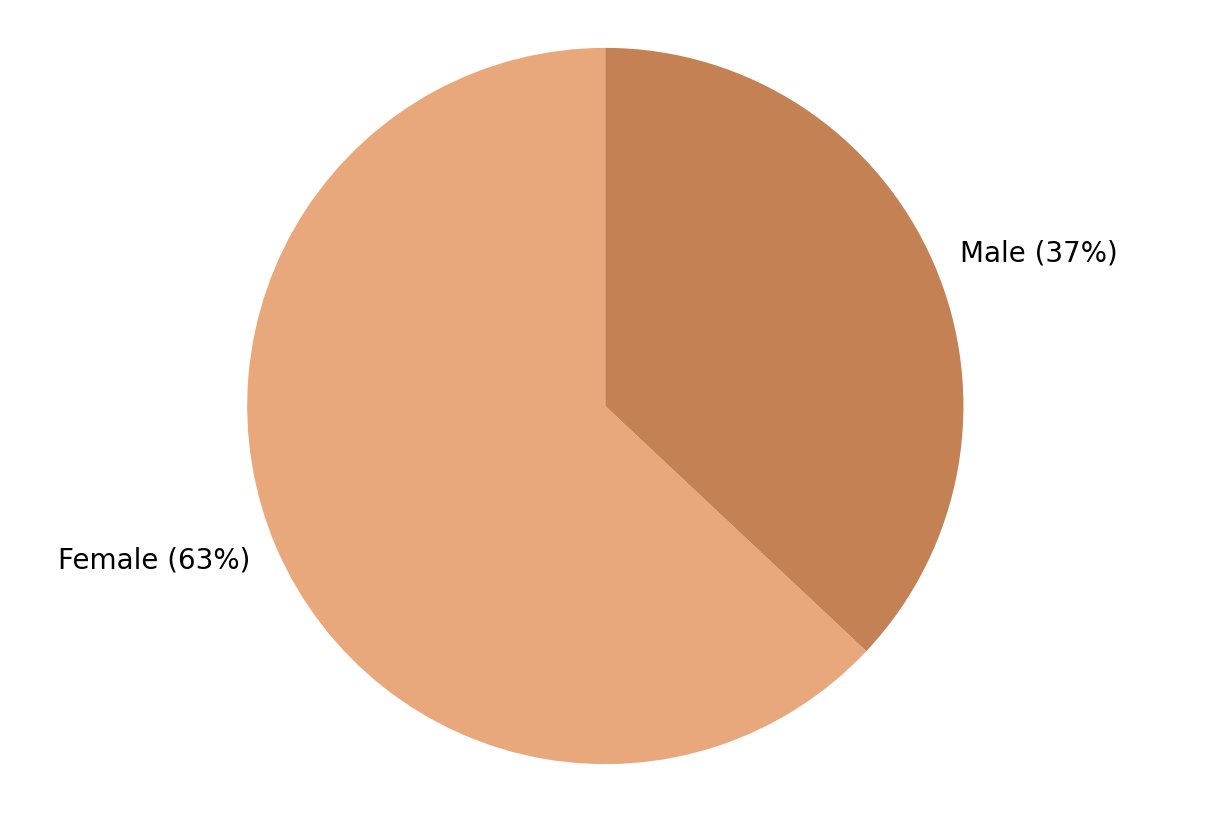
The pie chart shows the proportion of men and women among the 98 students who took part in the survey on online and distance teaching. Women were in the majority, with 63% of the sample (95% Wilson CI: 53.1%–71.9%), while men accounted for 37% (95% CI: 28.1%–46.9%). A chi-square goodness-of-fit test indicates that this distribution differs significantly from an even 50/50 split, χ²(1) = 6.90, p = .009. This means there are roughly 1.7 times more women than men in the sample.
This distribution may have several possible explanations, for example:
-
Women are more numerous than men in enrolling in or pursuing higher education in Algeria.
-
Women are more willing or available to respond to an online survey than men.
-
Women are more interested in or concerned with online and distance learning than men.
4.2. Level of study
Fig. 2 Level of study of the respondents
The bar chart shows the proportion of students by level of study among the 98 survey participants. Master's students were by far the largest group, at 61% of the sample (95% CI: 51.1%–70.1%), followed by Bachelor's students at 32% (95% CI: 23.6%–41.8%). PhD students were a small minority, at only 5% (95% CI: 2.1%–11.3%). A chi-square goodness-of-fit test confirms that this distribution differs significantly from an even split across the three levels, χ²(2) = 47.31, p < .001.
This distribution may have several possible explanations, for example:
-
Master's students are more concerned with online and distance teaching, as they have more theoretical coursework and research work than Bachelor's or PhD students.
-
Bachelor's or PhD students are less available or willing to respond to an online survey, as they have more practical coursework or fieldwork than Master's students.
4.3. Number of courses taken online
Fig. 3 Number of courses taken online
Most students, 59% (95% CI: 49.1%–68.2%), take several courses online, while 39% (95% CI: 29.9%–48.9%) take a single online course and 2% (95% CI: 0.5%–7.1%) take none. A chi-square goodness-of-fit test shows this distribution is significantly non-uniform, χ²(2) = 49.31, p < .001. This can be explained by the fact that students are compulsorily enrolled in these courses by the university, and the number of courses depends on the field of study and on the cross-curricular or discovery subjects that are taught exclusively at a distance this year.
4.4. Attendance at online classes
Fig. 4 Attendance at online classes
The chart shows the proportion of students by attendance level among the 98 survey participants. 28% of students (95% CI: 20.1%–37.6%) attended all classes (100% attendance), 51% (95% CI: 41.3%–60.7%) missed some classes (less than 100% attendance), and 19% (95% CI: 12.5%–27.9%) were present only for assessments (0% attendance). A chi-square goodness-of-fit test confirms a significantly non-uniform distribution, χ²(2) = 16.19, p < .001.
This distribution may have several possible explanations, for example:
-
Students who attended all classes are more serious about, or more engaged in, their studies than students who missed some classes or attended only for assessments.
-
Students who missed some classes or attended only for assessments are more distracted by, or less motivated by, online and distance teaching than students who attended all classes.
-
Students who missed some classes or attended only for assessments face more personal, professional or technical constraints or difficulties than students who attended all classes.
4.5. Preferred platform for taking online classes
Fig. 5 Preferred platform for online classes
The pie chart shows the proportion of students by preferred online platform among the 98 survey participants. 55% of students (95% CI: 45.1%–64.5%) prefer videoconferencing platforms (Zoom, Google Meet, etc.), 30% (95% CI: 21.8%–39.7%) prefer Moodle, and 13% (95% CI: 7.7%–21.1%) prefer Google Classroom. A chi-square goodness-of-fit test confirms this distribution is significantly non-uniform, χ²(2) = 26.69, p < .001.
This distribution may have several possible explanations, for example:
-
Students who prefer videoconferencing platforms value direct, interactive contact with teachers and other students, as well as the ability to ask questions or take part in real-time discussions.
-
Students who prefer Moodle value the flexibility and autonomy it offers, as well as the range of educational resources and activities it provides.
-
Students who prefer Google Classroom value the simplicity and user-friendliness it offers, as well as its easy integration with other Google services (Gmail, Drive, Docs, etc.).
The next question gives us further insight into participants' reasons for their preferences.
4.6. Reasons for choosing the platform
Fig. 6 Reasons for platform choice
Analysis of the results shows that students who took part in the survey had different motivations and expectations depending on the platform they preferred for taking their online classes. The main points are as follows:
-
Easy access: 52% of students (95% CI: 42.2%–61.6%) justified their choice of online platform by the easy access it offers, that is, the ease of connecting, navigating, downloading or consulting content and educational activities.
-
Motivation: 11% of students (95% CI: 6.2%–18.7%) justified their choice of online platform by the fact that it is motivating that is, it generates interest, engagement, enjoyment or satisfaction in learning.
The remaining 37% of responses cited other, more heterogeneous reasons not individually detailed here. A chi-square goodness-of-fit test on the three categories (easy access, motivation, other reasons) confirms a significantly non-uniform distribution, χ²(2) = 25.00, p < .001.
4.7. Perceived effectiveness of online and distance learning
Fig. 7 Perceived effectiveness of online and distance learning
Analysis of the results shows that students who took part in the survey held mixed views, depending on their experience and perception of this teaching modality. The main points are as follows:
-
Positive opinion: 59% of students (95% CI: 49.1%–68.2%) answered Yes, meaning they consider online and distance learning to be effective that is, it allows them to achieve learning objectives, develop their skills, progress in their studies, or adapt to health or geographic constraints.
-
Negative opinion: 30% of students (95% CI: 21.8%–39.7%) answered No, meaning they consider online and distance learning to be ineffective that is, it causes them problems with comprehension, motivation, interaction, follow-up, or access to resources or technology.
-
Neutral opinion: 9% of students (95% CI: 4.8%–16.3%) had no opinion, meaning they do not have a clear-cut view on the effectiveness of online and distance learning that is, they recognize both its advantages and disadvantages, or do not have enough information to form a judgement.
A chi-square goodness-of-fit test confirms this distribution is significantly non-uniform, χ²(2) = 37.94, p < .001.
4.8. Please specify (follow-up to 4.7)
“Yes” responses:
R1: Easy access.
R2: It proved its worth during the pandemic.
R3: It is the best modality indeed the only choice used by institutions during this epidemic crisis.
R4: Online teaching allows me to work and study at the same time.
R5: Yes, because during the pandemic it is essential to continue our studies even if it is at a distance.
R6: A perfect solution given the health protocol.
“No” responses:
R1: There is a lack of professionalism on this subject.
R2: There is no professional training for people adopting online learning, so there is no real return on investment.
R3: Distance learning never replaces face-to-face classes. Online classes are not really motivating.
R4: It is not straightforward for those who do not have a good Internet connection.
R5: Not everyone has access to the Internet or owns a computer.
Analysis of the results shows that students who took part in the survey put forward different arguments and opinions, depending on whether they answered Yes or No to the question: “In your opinion, is the adoption of online and distance learning effective?”
Key points:
-
Arguments in favor of the effectiveness of online and distance learning: students who answered Yes mainly cited notions of easy access, a solution to the pandemic, the ability to work and study at the same time, and a modality chosen by institutions. These arguments show that these students value the ease, flexibility, adaptability and relevance of online and distance learning.
-
Arguments against the effectiveness of online and distance learning: students who answered No mainly cited notions of lack of professionalism, training, motivation, Internet connectivity, and access to resources or technology. These arguments show that these students encounter problems of quality, competence, engagement, infrastructure or equipment in online and distance learning.
4.9. Are you assessed online?
Fig. 8 Proportion of students assessed online
Analysis of the results shows that students who took part in the survey are in different situations, depending on whether or not they are assessed online. The main points are as follows:
-
Online assessment: 73% of students (95% CI: 63.5%–80.8%) answered Yes, meaning they are assessed online that is, they take tests, exams, quizzes, assignments or projects on an online platform.
-
Offline assessment: 27% of students (95% CI: 19.2%–36.5%) answered No, meaning they are not assessed online that is, they take assessments in person, on paper, or have no assessment at all.
A chi-square goodness-of-fit test confirms this distribution differs significantly from an even 50/50 split, χ²(1) = 21.59, p < .001.
This distribution may have several possible explanations, for example:
-
Students who are assessed online benefit from an assessment method consistent with their teaching modality, allowing them to check their learning, receive feedback, or validate their distance training.
-
Students who are not assessed online are subject to an assessment method that differs from their teaching modality, which can create a mismatch, confusion, or inconsistency between their learning and their assessment.
4.10. Perceived relevance of online assessment
Fig. 9 Perceived relevance of online assessment
Analysis of the results shows that students who took part in the survey held very divergent opinions on whether online assessment is relevant. The main points are as follows:
-
Positive opinion: 25% of students (95% CI: 17.5%–34.4%) answered Yes, meaning they find online assessment relevant that is, it matches the learning objectives, content and activities of the online course, correctly measures their learning, provides them with useful feedback, or allows them to validate their distance training.
-
Negative opinion: 64% of students (95% CI: 54.1%–72.8%) answered No, meaning they find online assessment not relevant that is, it does not match the learning objectives, content and activities of the online course, poorly measures their learning, does not provide useful feedback, or does not allow them to validate their distance training.
-
Neutral opinion: 11% of students (95% CI: 6.2%–18.7%) were neutral, meaning they do not have a clear-cut opinion on the relevance of online assessment that is, they recognize both its advantages and disadvantages, or do not have enough information to form a judgement.
A chi-square goodness-of-fit test confirms this distribution is significantly non-uniform, χ²(2) = 44.84, p < .001.
4.11. Please specify why (follow-up to 4.10)
“Yes” responses
R1: We have the opportunity to do research at the same time.
R2: We are freer, less stressed.
R3: Yes, because we are already researchers, so through these assessments we engage with either educational or pedagogical research...
R4: We can schedule it according to our availability.
“No” responses
R1: It does not reflect the student's true level.
R2: People can get good grades without even knowing the course material.
R3: I don't know how teachers’ grade.
R4: Sometimes, because the marking grid is not shown to the student, who cannot then be satisfied with the grades displayed. This obviously does not apply to lazy students who only like to copy and paste.
R5: In-person assessment is more credible.
R6: Students can cheat without any effort.
Analysis of the results shows that students who took part in the survey applied different criteria and held different opinions, depending on whether or not they found online assessment relevant. The main points are as follows:
-
Criteria in favor of the relevance of online assessment: students who answered Yes mainly cited notions of opportunity, freedom, research and scheduling. These criteria show that these students value the flexibility, autonomy, curiosity and organization that online assessment offers them.
-
Criteria against the relevance of online assessment: students who answered No mainly cited notions of level, grades, assessment, marking grids and credibility. These criteria show that these students encounter problems of reliability, transparency, quality or fairness in online assessment.
4.12. Preference for continuing online/distance teaching post-COVID
Fig. 10 Preference for continuing online/distance teaching post-COVID
Analysis of the results shows that students who took part in the survey had different preferences depending on whether or not they wished this teaching modality to continue after the health crisis. The main points are as follows:
-
Positive: 59% of students (95% CI: 49.1%–68.2%) answered Yes, meaning they wish online and distance teaching to remain part of university practice post-COVID that is, they value the advantages of this teaching modality, such as flexibility, autonomy, diversity, or accessibility.
-
Negative: 27% of students (95% CI: 19.2%–36.5%) answered No, meaning they do not wish online and distance teaching to remain part of university practice post-COVID that is, they weigh more heavily the disadvantages of this teaching modality, such as the lack of interaction, motivation, follow-up, or quality.
-
Neutral: 14% of students (95% CI: 8.5%–22.2%) had no opinion, meaning they have no clear preference regarding the continuation of online and distance teaching post-COVID that is, they recognize both its advantages and disadvantages, or do not have enough information to form a judgement.
A chi-square goodness-of-fit test confirms this distribution is significantly non-uniform, χ²(2) = 31.67, p < .001.
5. Discussion
Discussion of the survey results highlights several important aspects of online and distance teaching at the Algerian university, from the perspective of the students surveyed. The main conclusions that emerge are as follows:
The choice of distance-teaching platform is a determining factor in the quality of the teaching/learning process. Students emphasize the significant impact of the platform used on their online learning experience. This implies that Algerian universities must select and provide suitable platforms that meet students' needs (Slimani & Bentahar, 2019).
Among the various platforms available, students show a preference for videoconferencing platforms such as Meet and Zoom. The reasons for this preference are linked to the possibility of direct exchanges and instant interaction between learners and teachers. Videoconferencing platforms offer students a virtual classroom environment that more closely simulates face-to-face interaction (Achab, 2023).
The live-broadcast mode is the most appreciated by the students surveyed. This mode allows easy access via a direct link or a copied access code. Students appreciate the simplicity and ease of use of these platforms, which facilitates their active participation in online classes.
Online and distance assessment needs to be reviewed by higher-education institutions. The survey results show that learners feel their grades do not faithfully reflect their real personal effort. This raises the need to develop more suitable and equitable online assessment methods to evaluate students' knowledge and skills in the context of distance education.
The students surveyed recognize the effectiveness of online/distance teaching and learning in times of crisis. They consider distance teaching to be an excellent way of continuing the learning process, enabling course continuity and offering opportunities to acquire knowledge despite exceptional circumstances (Achab, 2023).
These findings echo, while nuancing, those of Laifa et al. (2023) obtained with a much larger sample (n = 782): in both studies, students' perceived ease of use of digital tools is the main driver of satisfaction, which is consistent with the preference expressed here for videoconferencing platforms, seen as easier to access. Our results also corroborate the findings of Bengueddach et al. (2023) on the ability of DTL to ensure satisfactory pedagogical continuity in times of crisis, while echoing the work of Zine et al. (2023, 2025), who identify stakeholder awareness and motivation more than mere technical availability as the key determinants of sustainable adoption of educational technology in Algerian universities. Students' distrust of online assessment, for its part, echoes similar findings reported in other university contexts across the Maghreb, where a perceived lack of control over exam conditions fuels doubts about the validity of grades obtained remotely.
These conclusions highlight the importance of choosing suitable, user-friendly platforms for distance teaching/learning (Allen et al., 2002), with particular emphasis on videoconferencing platforms that foster direct interaction between students and teachers. They further underline the need to rethink online assessment methods to ensure fair and representative assessment of students' efforts. Finally, they confirm that online teaching/learning is an effective way of maintaining pedagogical continuity, particularly in crisis situations.
6. Conclusion
Online/distance teaching and learning at the Algerian university has evolved rapidly, driven by technological advances and the COVID-19 pandemic. The results of our student survey highlighted the importance of the choice of distance-teaching platform, with a marked preference for videoconferencing platforms such as Meet and Zoom. Students also emphasized the effectiveness of online teaching in times of crisis, while highlighting challenges such as the online assessment system and the representativeness of grades.
These results address the hypothesis put forward in the introduction and confirm the interest of our study. They also demonstrate the originality and contribution of our research to the scientific and pedagogical field of distance teaching/learning.
Based on these conclusions, we make the following recommendations to improve distance teaching/learning at the Algerian university:
-
Select suitable, user-friendly platforms, giving priority to those offering real-time interaction, content-sharing, and direct exchange between learners and teachers.
-
Train teachers in the use of distance-teaching technologies, helping them acquire the skills to plan and deliver online classes interactively, encourage student engagement, and foster virtual communication.
-
Revise online assessment methods to ensure fair and equitable assessment of students' knowledge. Consider innovative approaches, such as project-based assessments, online discussions, and formative assessments.
-
Provide reliable and affordable Internet access to students, particularly in rural areas. Develop partnership initiatives with Internet service providers and government bodies to improve online accessibility.
-
Set up psychological and social support mechanisms for students in distance education. This may include online counselling services, virtual support groups, and resources to help students manage stress and maintain their mental well-being.
In conclusion, online/distance teaching and learning at the Algerian university has made significant progress through the use of suitable technologies and platforms. However, further efforts are needed to improve accessibility, the quality of assessment, and teacher training. By investing in these areas, Algerian universities can strengthen the effectiveness of online/distance teaching and learning, provide a quality educational experience, and prepare students to meet the challenges of an ever-evolving digital world.
References
- Achab, D. (2023). L’enseignant face à la pandémie : quels besoins ? Studii de gramatică contrastivă, 39, 1–15. DOI ↗ Google Scholar ↗
- Allen, M., Bourhis, J., Burrell, N., & Mabry, E. (2002). Comparing Student Satisfaction With Distance Education to Traditional Classrooms in Higher Education: A Meta-Analysis. American Journal of Distance Education 16(2), 83–97. DOI ↗ Google Scholar ↗
- Arrar, S. (2021). Défis et perspectives de l’enseignement à distance au supérieur Algérien : cas de l’ENS de Sétif pendant la crise pandémique du COVID-19. Review of Psychological and Educational Studies, 14(2s), 1116–1128. DOI ↗ Google Scholar ↗
- Bengueddach, A., Boudia, C., & Bouamrane, K. (2023). Interpretive analysis of online teaching labs constructed using Moodle during the pandemic period. Heliyon, 9(5), e16007. DOI ↗ Google Scholar ↗
- Bertrand, L. (2010). Renouveler l’université : pour un rapport au savoir adapté au XXIe siècle. Presses de l’Université Laval. DOI ↗ Google Scholar ↗
- Bonfils, P. (2020). Repenser les dispositifs de formation à l’aune de la pandémie ? Distances et médiations des savoirs, 31/2020. DOI ↗ Google Scholar ↗
- Boufalta, M. S., & Bessette, L. (2021). L’enseignement à distance en état d’urgence : étude des procédures de l’enseignement à distance des universités algériennes face à la pandémie du coronavirus. El-Acil Journal for Economic and Administrative Research, 5(1), 1–18. DOI ↗ Google Scholar ↗
- Centre de Recherche sur l’Information Scientifique et Technique [CERIST], & Ministère de l’Enseignement Supérieur et de la Recherche Scientifique [MESRS]. (2020). Plateforme nationale d’e-learning des établissements d’enseignement supérieur algériens. https://elearn.cerist.dz Google Scholar ↗
- Darby, F. (2021). 7 Dos & Don’ts for Post-Pandemic Teaching With Technology. Chronicle of Higher Education. Google Scholar ↗
- Laifa, M., Imani Giglou, R., & Akhrouf, S. (2023). Blended Learning in Algeria: Assessing Students’ Satisfaction and Future Preferences Using SEM and Sentiment Analysis. Innovative Higher Education, 48(5), 879–905. DOI ↗ Google Scholar ↗
- Lassassi, M., Lounici, N., Sami, L., Tidjani, C., & Benguerna, M. (2020). Université et enseignants face au COVID-19 : l’épreuve de l’enseignement à distance en Algérie. Les Cahiers du Cread, 36(3), 1–22. DOI ↗ Google Scholar ↗
- Lollia, M., & Issaieva, E. (2020). Comment les enseignants assurent la continuité pédagogique et évaluent en contexte de pandémie ? Une étude en Guadeloupe. Évaluer. Journal international de recherche en éducation et formation, Numéro Hors-série, 1, 181–192. http://journal.admee.org/index.php/ejiref/article/view/231 DOI ↗ Google Scholar ↗
- Ministère de l’Enseignement Supérieur et de la Recherche Scientifique [MESRS]. (n.d.). Textes juridiques. Retrieved August 28, 2026, from https://www.mesrs.dz/index.php/fr/textes-juridiques/ Google Scholar ↗
- Okmawati, M. (2020). The Use of Google Classroom during Pandemic. Journal of English Language Teaching. http://ejournal.unp.ac.id/index.php/jelt/article/view/109293 Google Scholar ↗
- Slimani, R., & Bentahar, F. (2019). L’enseignement à distance et le e-learning dans les établissements universitaires algériens : défis et acquis. AL-LISĀNIYYĀT, 25(1), 84–103. https://www.asjp.cerist.dz/en/downArticlepdf/26/25/1/94081 Google Scholar ↗
- Sun, L., Tang, Y., & Zuo, W. (2020). Coronavirus pushes education online. Nature Materials, 19, 687. DOI ↗ Google Scholar ↗
- Vidal, M. (2020). L’enseignement à distance, trait d’union en temps de pandémie. Distances et médiations des savoirs, 2020(32). DOI ↗ Google Scholar ↗
- Zine, M., Harrou, F., Terbeche, M., & Bellahcene, M. (2023). E-Learning Readiness Assessment Using Machine Learning Methods. Sustainability, 15(11), 8924. DOI ↗ Google Scholar ↗
- Zine, M., Harrou, F., Terbeche, M., & Sun, Y. (2025). Evaluating e-learning readiness using explainable machine learning and key organizational change factors in higher education. Education and Information Technologies. DOI ↗ Google Scholar ↗